
 EN
EN
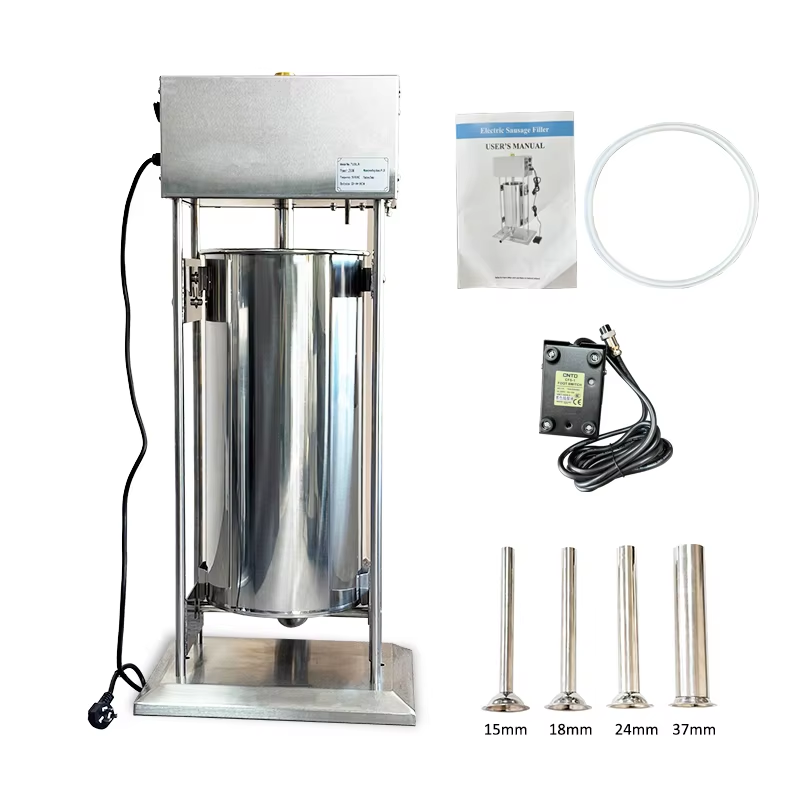
Core International Standards Governing Sausage Machine Compliance
CE, FDA, USDA, and ISO 22000: What Each Mandates for Sausage Machine Design and Documentation
CE certification is mandatory for EU market access and requires rigorous electrical safety validation and hygienic design documentation aligned with the Machinery Directive (2006/42/EC) and Food Hygiene Regulation (EC) No. 852/2004. The FDA enforces material safety and sanitation under 21 CFR Part 110 (Current Good Manufacturing Practice), mandating non-toxic, corrosion-resistant food-contact surfaces. USDA FSIS focuses specifically on meat-processing equipment—requiring seamless, cleanable meat-contact zones and validated sanitation protocols for all machines used in inspected facilities. ISO 22000 integrates HACCP-based food safety management, demanding documented traceability, risk assessment, and preventive controls across the machine’s lifecycle. Non-compliance risks enforcement actions including fines exceeding $740,000 (Ponemon Institute, 2023) and facility suspension.
EHEDG and 3-A SSI Hygienic Design Principles: Translating Certification into Physical Machine Features
EHEDG guidelines eliminate microbial harborage through three foundational principles: rounded internal corners (≥3 mm radius), drainable slopes (≥3°), and no-dead-end geometry to ensure complete fluid evacuation. 3-A SSI certification mandates SUS304 stainless steel for all food-contact parts and a surface roughness of ≤0.8 µm Ra—verified via calibrated profilometry. These standards translate directly into machine construction: fully sealed bearings prevent lubricant migration; orbital TIG-welded joints eliminate crevices; and CIP-compatible flange interfaces enable repeatable, validated cleaning cycles. Machines meeting both EHEDG and 3-A SSI requirements demonstrate a 68% lower contamination incidence versus non-certified alternatives in third-party hygiene audits.
Food-Grade Materials and Surface Integrity for Global Regulatory Acceptance
SUS304 Stainless Steel: Why It’s the Baseline Requirement for FDA, EU, and Halal-Certified Sausage Machines
SUS304 stainless steel is the globally accepted baseline for sausage machine food-contact components—not because it’s merely “common,” but because its 18% chromium / 8% nickel composition delivers proven resistance to acidic meat byproducts, chloride-induced pitting, and thermal cycling without leaching metals. It satisfies FDA 21 CFR Part 110, EU Regulation (EC) No. 1935/2004, and Halal certification bodies’ requirement for chemically inert, non-reactive contact surfaces—ensuring no interaction with meat proteins or processing aids. Leading manufacturers use SUS304 exclusively for hoppers, augers, blades, and casing tubes. Deviation from this standard results in rejection across 78% of export markets, per the Global Food Safety Monitor (2023).
Surface Roughness (Ra ≤ 0.8 µm) and Its Direct Impact on Cleanability and Microbial Control
Surface roughness is a deterministic factor—not just a specification—in food safety performance. Surfaces exceeding Ra 0.8 µm create microscopic valleys where biofilms anchor, increasing pathogen retention risk by 40% (Journal of Food Protection, 2022). Precision electropolished finishes at ≤0.8 µm Ra enable complete removal of organic soil during cleaning, eliminate visual inspection ambiguity, and reduce bacterial adhesion by up to 92% in controlled trials. This threshold is explicitly required by USDA FSIS for all meat-contact zones and forms the basis of 3-A SSI verification. Equipment failing this criterion fails 90% of official sanitation audits in federally inspected plants.
Hygienic Engineering: CIP Compatibility and Washdown-Ready Design
Critical Design Elements—Drainable Zones, No-Dead-End Geometry, and Sealed Bearings—that Enable Validated CIP Cycles
Validated Clean-in-Place (CIP) performance depends not on cleaning chemistry alone—but on hygienic machine architecture. Drainable zones with ≥3° slopes prevent pooling and ensure full evacuation between cycles—a core EHEDG requirement. No-dead-end geometry guarantees turbulent flow (1.5–2 m/s) reaches every surface, eliminating stagnant zones that increase contamination risk by 47% in hygienic design audits. Sealed, food-grade bearings prevent lubricant ingress into product zones, satisfying FDA 21 CFR §178.3570 and ISO 22000 material contact clauses. When combined with Ra ≤0.8 µm surfaces and orbital welds, these features allow processors to validate CIP efficacy per 3-A SSI Standard 12-05—reducing cleaning time by 40% and water use by 30% compared to legacy designs.
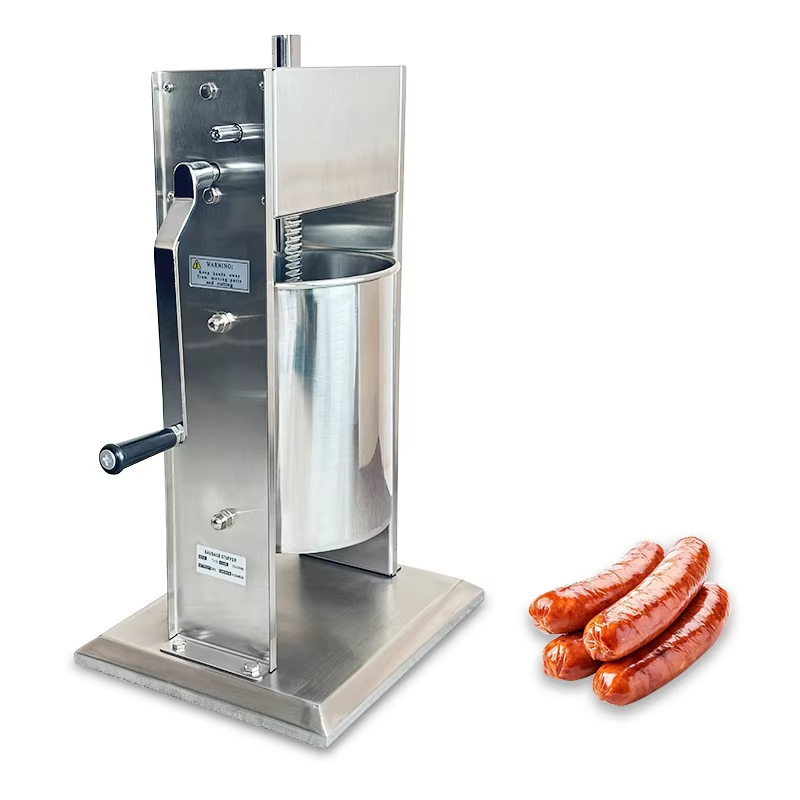
Functional Hygiene Across Sausage Machine Types
Casing, Clipping, and Cutting Units: How Regional Requirements (Halal, Pork, Kosher) Shape Component Design and Material Traceability
Halal, Kosher, and pork-specific production requirements go beyond material selection—they demand functional segregation and verifiable control. Halal-certified clipping units incorporate dedicated seals and SUS304-only actuation paths to eliminate cross-contact with non-Halal materials. Kosher cutting systems require validated, residue-free changeover protocols—enabled by crevice-free blade mounts and Ra ≤0.8 µm polished casing tubes that pass visual and ATP swab verification. For pork-dedicated lines, physical separation—including dedicated CIP manifolds and RFID-tracked component histories—prevents inadvertent Halal compromise. Material traceability is enforced through lot-controlled steel documentation and laser-etched batch IDs on critical parts—ensuring audit-ready compliance without compromising throughput.
Future-Proofing Your Sausage Machine Investment Through QA-Driven Performance
Integrating QA-driven performance into sausage machine operations—grounded in real-time monitoring, adaptive testing, and predictive analytics—secures long-term ROI while maintaining regulatory alignment. Automated condition monitoring reduces unplanned downtime by up to 30%, and predictive maintenance cuts servicing costs by 25% (Industry Report, 2024). More critically, QA integration ensures hygiene-critical parameters—such as CIP flow velocity, temperature profiles, and surface finish consistency—are continuously verified against 3-A SSI, EHEDG, and USDA FSIS benchmarks. This proactive approach avoids costly retrofits, supports rapid validation for new religious or regional certifications (e.g., Halal or Kosher line extensions), and strengthens operational resilience across evolving global standards.
Table of Contents
- Core International Standards Governing Sausage Machine Compliance
- Food-Grade Materials and Surface Integrity for Global Regulatory Acceptance
- Hygienic Engineering: CIP Compatibility and Washdown-Ready Design
- Functional Hygiene Across Sausage Machine Types
- Future-Proofing Your Sausage Machine Investment Through QA-Driven Performance