
 EN
EN
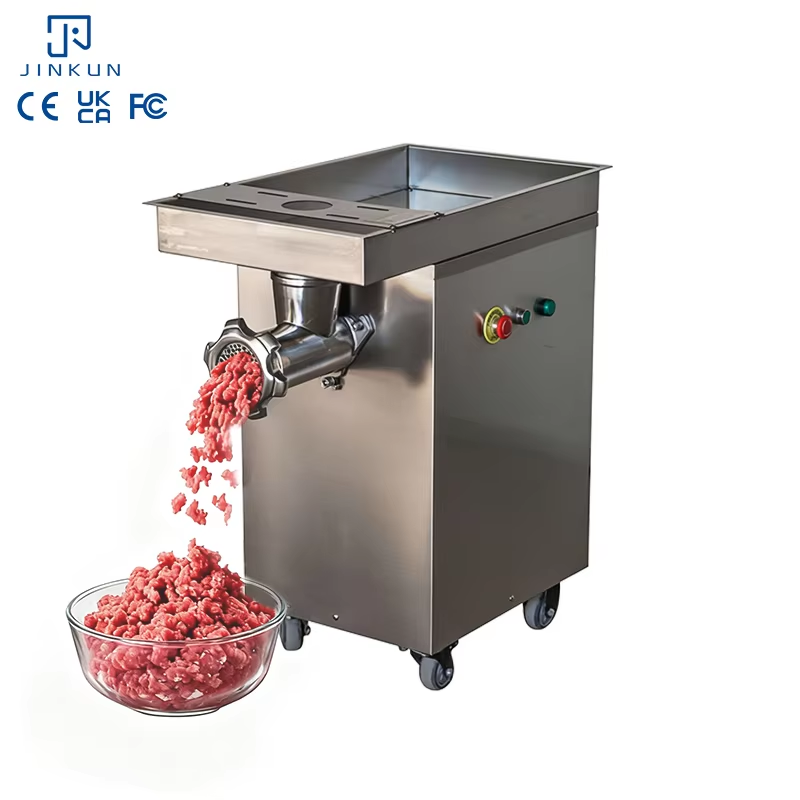
The Engineering Demands of Heavy-Duty Meat Grinding
Torque vs. RPM: How Motor Power Prevents Jamming and Ensures Consistent Output
When grinding tough cuts or semi-frozen meat, standard motors frequently stall—disrupting workflow and compromising consistency. Heavy-duty grinders prioritize torque over RPM because torque delivers the rotational force needed to push dense material steadily through the auger without slowing down. While RPM affects feed speed, it’s torque that sustains pressure under load and prevents meat from compacting into jams. A high-torque motor (3–5 HP) maintains uniform auger engagement, ensuring consistent particle size and minimizing interruptions. In contrast, high-RPM, low-torque units lose power when resistance increases, leading to uneven grinding and frequent stops. Real-world operational data shows machines with 3 HP+ motors achieve 90–95% uptime during 8–12 hour shifts—significantly outperforming standard models, which often fall below 70% uptime under similar conditions.
Frozen Meat and Dense Cuts: Real-World Stress Tests for a Heavy-Duty Meat Grinder
Processing semi-frozen meat or sinew-rich cuts is among the most demanding tasks for any grinder—and a definitive benchmark for true heavy-duty capability. In commercial trials, units with 3–15 HP motors consistently process over 2,200 lbs/hour without thermal throttling or performance loss. Their tapered augers resist compaction, while hardened stainless steel cutting plates shear through ice crystals and fibrous tissue with minimal wear. For instance, a midsize commercial kitchen processing 500 lbs of frozen beef daily saw a 60% throughput increase after upgrading to a 5 HP grinder—without sacrificing texture or requiring operator intervention. Unlike consumer-grade equipment prone to motor burnout or rapid blade dulling, these systems sustain steady output across continuous loads, making them indispensable where production pauses are operationally unacceptable.
Motor Specifications That Define True Heavy-Duty Performance
Why 1 HP+ Motors Deliver Reliable Power Without Overheating
A motor rated at 1 HP or higher isn’t just a spec—it’s the baseline requirement for reliable, uninterrupted grinding in commercial environments. Units below this threshold commonly overheat when handling large volumes or connective tissues, triggering thermal shutdowns and inconsistent results. Higher horsepower provides essential torque reserves, enabling the grinder to maintain steady output under load rather than stalling or jamming. A 1 HP motor can typically process 15–20 lbs/minute of chilled beef without strain; weaker units often bog down at just 5–8 lbs (Plant Engineering, 2024). This margin also buffers against voltage drops during startup surges—a known failure point in underpowered models. Moreover, IE3-efficiency-rated motors reduce energy waste by up to 15% compared to standard units, directly lowering operating costs during extended production runs.
Wattage, Duty Cycle, and Build Quality: Beyond Marketing Claims in Meat Grinder Specs
Evaluating heavy-duty grinders demands scrutiny beyond headline horsepower. Sustained wattage—not peak—is the clearest indicator of real-world power delivery: look for ≥1200W continuous output. Duty cycle reveals true endurance: commercial-grade units support 60+ minutes of uninterrupted operation before cooling is required, whereas residential models often max out at 15 minutes. Build quality further separates durable performers from short-lived alternatives:
| Component | Low-Grade Indicator | Heavy-Duty Standard |
|---|---|---|
| Motor Housing | Thin stamped steel | Cast aluminum alloy |
| Bearings | Sleeve bushings | Sealed ball bearings |
| Cooling | Passive vents | Fan-assisted + copper windings |
Copper-wound motors, for example, reliably withstand 2,000+ operational hours before measurable degradation—four times longer than aluminum-wound counterparts limited to ~500 hours. Independent lab testing remains critical: verify that units maintain stable RPM and stay below 140°F under sustained load—the temperature at which motor insulation begins to break down.
Commercial Applications Where a Heavy-Duty Meat Grinder Is Non-Negotiable
Butcher Shops and Delis: High-Volume Grinding Without Downtime or Degradation
For butcher shops and delis, a heavy-duty meat grinder isn’t an upgrade—it’s foundational infrastructure. These operations regularly grind hundreds of pounds per hour during peak windows, and even brief interruptions erode margins, delay orders, and compromise freshness. Standard residential grinders lack the torque to handle dense cuts or partially frozen product without jamming or overheating. Heavy-duty models—especially those with #22 or #32 plate sizes—deliver the mechanical authority needed for continuous, high-volume output. They preserve texture integrity across batches, ensure repeatable particle size for sausages and burger patties, and support custom blends that differentiate brands and drive customer loyalty. With robust construction and thermal management built for all-day use, these grinders reduce labor overhead, minimize waste from regrinds or spoilage, and enable scalable production—all without sacrificing food safety or consistency.
FAQ
What is the main advantage of torque over RPM in heavy-duty meat grinders?
Torque provides the rotational force needed to push dense material through the grinder, ensuring consistent output and preventing jams.
How much horsepower is ideal for heavy-duty meat grinders?
Heavy-duty meat grinders typically require 3–5 HP for optimal performance, handling tough cuts and dense materials.
Why is sustained wattage important in meat grinder specs?
Sustained wattage indicates consistent power delivery, ensuring continuous operation without overheating or slowing down.
What differentiates commercial-grade grinders from consumer-grade models?
Commercial-grade grinders have higher horsepower, enhanced durability, efficient cooling systems, and the ability to operate continuously under heavy loads.
How do heavy-duty meat grinders benefit butcher shops and delis?
These grinders ensure high-volume output, reduce downtime, maintain texture integrity, and support customizable blends, making them essential for consistent production.