
 EN
EN
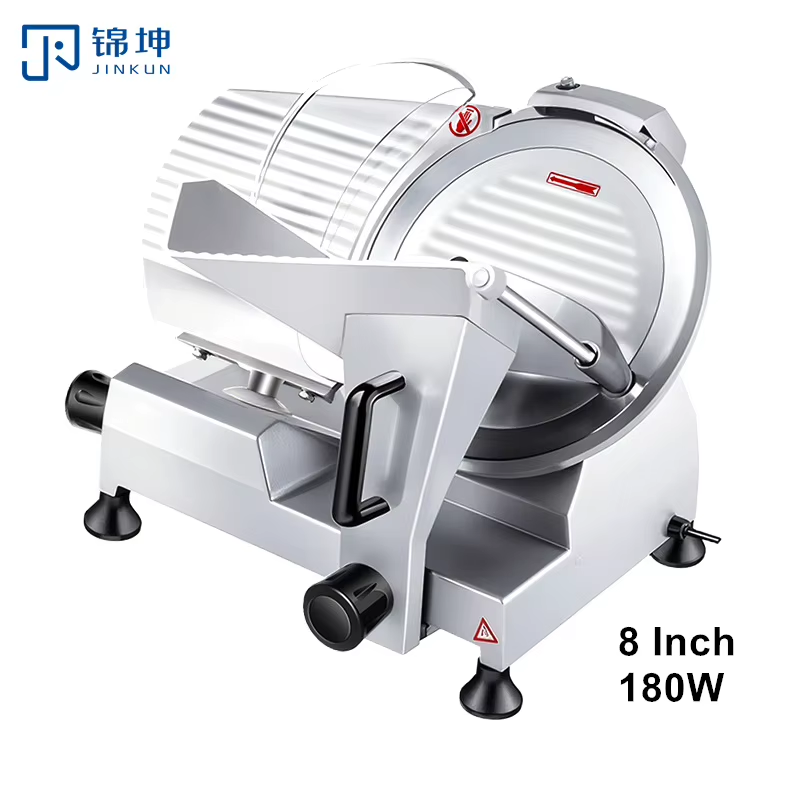
The Strategic Fit: Why Semi-Automatic Slicers Align with Real-World Kitchen Constraints
The semi-automatic slicer is not merely a step up from manual models—it’s a strategic solution engineered for the constraints of real commercial kitchens. Space is universally tight in delis, butcher shops, and catering operations, where every square foot must multitask. Unlike fully automatic units that demand dedicated floor space and permanent installation, semi-automatic slicers typically occupy 30–40% less counter area. Their compact footprint fits seamlessly into existing workstations—preserving workflow continuity between cold storage, prep zones, and service counters. Most weigh under 150 pounds and run on standard 120V outlets, eliminating costly electrical upgrades or structural reinforcement. This plug-and-play design enables full deployment in under an hour, with zero operational disruption.
Beyond physical integration, these slicers optimize labor. The motorized carriage automates the repetitive pushing motion, shifting the operator’s role from physical exertion to precise loading and quality inspection. That shift reduces fatigue while maintaining consistent slice thickness and weight—even during peak-volume runs. In high-turnover environments, the shallow learning curve accelerates onboarding and minimizes errors. The result is measurable productivity gain without requiring kitchen redesign or specialized training.
Physical and Operational Integration: Minimal Retrofitting, Maximum Compatibility
Integrating a semi-automatic slicer rarely demands disruptive overhauls. These machines are built for pragmatic retrofitting—refining workflows rather than reconstructing them. They prioritize compatibility with legacy layouts, allowing teams to retain established movement patterns and station configurations while upgrading precision and throughput.
Footprint, power, and countertop requirements for seamless drop-in replacement
Most semi-automatic slicers match the countertop footprint of manual units—typically 18–24 inches wide—enabling direct physical replacement without layout changes. They operate on standard 120V single-phase power, a universal building supply that avoids electrical retrofitting. Feed tray and discharge heights align with those of manual slicers, preserving staff muscle memory and minimizing retraining. The adjustment is behavioral, not spatial: operators transition from full manual control to guided carriage operation.
Data point: 78% of delis report <2 hours of retrofitting time (2023 NSF Survey)
A 2023 National Sanitation Foundation (NSF) survey found that 78% of delicatessens completed full integration—including unpacking, blade sanitation, counter mounting for stability, and brief operator training—in under two hours. This rapid adoption reflects a calibration-focused process, not construction. With downtime contained within a single shift, return on investment begins immediately—no multi-day production losses required.
Operator-Centric Workflow Benefits: Faster Training, Lower Fatigue, Consistent Output
Semi-automatic slicers are designed around the people who use them: reducing physical strain, cognitive load, and variability—without sacrificing control. This human-centered engineering directly supports high-turnover kitchens and demanding production schedules, enabling new hires to contribute meaningfully within hours.
How semi-automatic feed mechanisms reduce operator fatigue by up to 42%
Manual slicing imposes repetitive stress on shoulders, arms, and hands—fatigue that slows output and raises error rates. Semi-automatic models use motorized feed trays or spring-loaded carriages to advance product toward the blade automatically. Operators position and guide only, eliminating forceful pushing. Pilot studies in commercial delis show this assistance can cut muscle exertion by up to 42%. The outcome? Fewer breaks, steadier performance across long shifts, and lower risk of repetitive strain injuries—critical advantages in high-volume settings.
Standardized blade settings as drivers of repeatability—not just safety
Standardized blade settings do more than improve safety: they guarantee uniform slice thickness across every batch. Once the thickness dial is set, consistency follows—no guesswork, no rework. That repeatability supports precise portion control, reduces waste from over-thick or over-thin slices, and shortens training. New staff achieve reliable results from day one using a single setting. Paired with ergonomic feed mechanics, these controls make the semi-automatic slicer a tool that simultaneously strengthens operator well-being and product integrity.
Measurable Time Savings in High-Volume Settings
In high-volume food service, seconds per order compound into meaningful labor savings—and lost opportunity. Semi-automatic slicers target the manual slicing bottleneck head-on, automating blade movement while retaining operator control over positioning. The result is faster, more predictable prep—freeing staff to focus on assembly, service, and customer engagement. Even a 30-second reduction per order unlocks dozens of additional covers during lunch rush. Real-world impact confirms this:
Case Study: A Regional Deli Chain Cuts Average Slice Prep Time from 92 Seconds to 37 Seconds
After installing semi-automatic slicers across five locations, a regional deli chain measured a dramatic improvement: average slice prep time dropped from 92 seconds to 37 seconds per sandwich—a 60% reduction. The automated feed and precision thickness settings enabled workers to produce perfectly portioned slices in under two seconds. That efficiency gain translated to over 100 additional sandwiches per shift, per location. Staff also reported reduced fatigue and fewer slicing errors—further smoothing operations. Industry benchmarks confirm this pattern: high-volume delis adopting semi-automatic slicers typically see throughput improvements of 40–60%.
FAQ
What is a semi-automatic slicer?
A semi-automatic slicer is a type of food slicer that combines manual and automatic features. It includes motorized components to reduce operator effort while still allowing precision and control during slicing.
How does a semi-automatic slicer save time?
The motorized carriage automates repetitive motions, making the slicing process quicker while maintaining accuracy. This efficiency can cut average slice prep time by more than half, as shown in real-world case studies.
Are semi-automatic slicers easy to integrate into existing kitchens?
Yes, they are designed for seamless integration with minimal retrofitting. They typically use standard power outlets and match the dimensions of manual slicers, making them a plug-and-play solution.
Do semi-automatic slicers require extensive retraining for staff?
No, their ergonomic designs and standardized settings minimize the learning curve. Most staff can adapt quickly, which is beneficial in high-turnover environments.
What are the ergonomic benefits of semi-automatic slicers?
These slicers reduce physical exertion by automating the feed mechanism. Studies show they can reduce operator fatigue by up to 42%, enhancing productivity and reducing the risk of repetitive strain injuries.
Table of Contents
- The Strategic Fit: Why Semi-Automatic Slicers Align with Real-World Kitchen Constraints
- Physical and Operational Integration: Minimal Retrofitting, Maximum Compatibility
- Operator-Centric Workflow Benefits: Faster Training, Lower Fatigue, Consistent Output
- Measurable Time Savings in High-Volume Settings
- FAQ