
 EN
EN
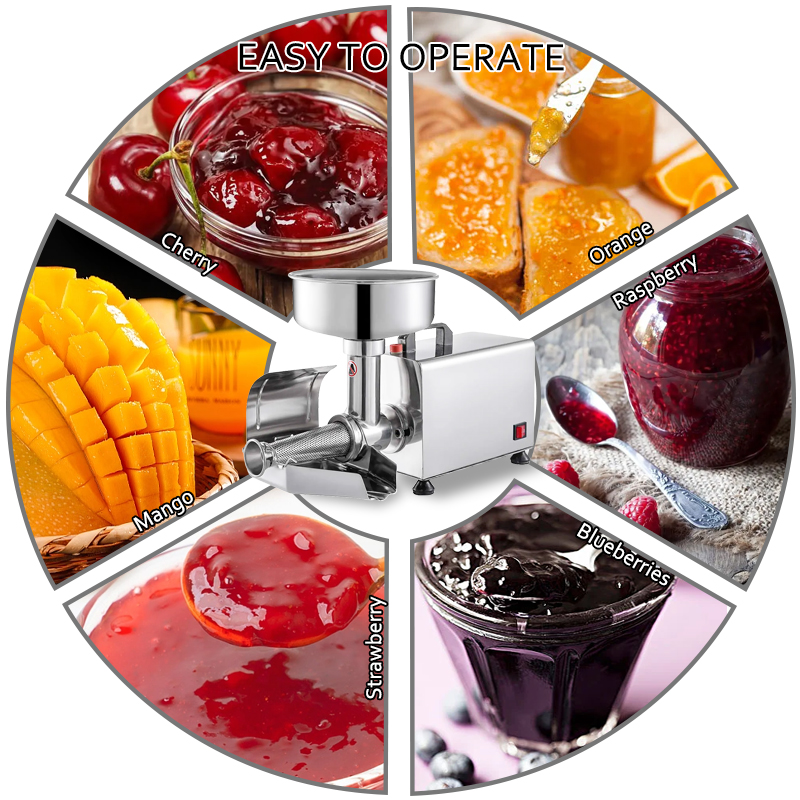
Precision Customization for Brix Levels and Exotic Fruit Formulations
Adaptive Sugar Concentration Control for Target Brix Accuracy
Maintaining consistent sweetness in exotic fruit formulations requires real-time Brix measurement and automated sugar dosing. Modern jam machines integrate inline refractometers that continuously monitor soluble solids, enabling dynamic sugar adjustment within seconds. This closed-loop control compensates for natural fruit variability—strawberries (7–10 °Bx), blueberries (12–14 °Bx), raspberries (5–8 °Bx), blackberries (6–9 °Bx), cherries (12–16 °Bx), and mango purée—ensuring uniformity despite raw material fluctuations. Industry standards classify strawberry taste quality as good above 8 °Bx and excellent above 9 °Bx, underscoring the sensory impact of precise control. For heat-sensitive or high-value fruits, accurate sugar concentration balances tartness without dulling delicate aromas. The system uses a target Brix setpoint—typically 65–68 °Bx—and automatically recalculates the sugar-to-fruit ratio while accounting for pectin and acid additions. This ensures batch-to-batch consistency in spreadability, gel strength, and shelf stability across diverse formulations.
Gentle Thermal-Shear Processing for Heat-Sensitive Fruits
Exotic fruits like guava, passion fruit, and dragon fruit contain volatile flavor compounds and anthocyanins highly susceptible to thermal degradation and mechanical shear. To preserve their sensory integrity, modern jam machines employ low-temperature vacuum cooking (50–65 °C under reduced pressure), enabling gentle water evaporation while retaining bright color and fresh top notes. Specialized agitation—featuring gentle-sweep paddles and variable-speed drives—minimizes shear stress, protecting fragile cell structures and preventing pectin-clouding substances from leaching into the matrix. In-line viscometers provide continuous feedback on consistency, allowing real-time adjustments to agitation without compromising gel formation. This level of precision is especially critical for raspberry, where excessive heat rapidly oxidizes anthocyanins, shifting vibrant red hues toward brown. It also enables a single machine to produce both smooth jam and whole-fruit preserves from the same strawberry batch—by switching agitation profiles mid-process—delivering authentic fruit identity, high-color retention, and clean-label texture demanded by premium retail and food-service channels.
Scalable Batch Flexibility Across Jam, Jelly, and Preserve Production
The ability to quickly switch between product types is essential for commercial jam operations.
Modular Vessel Sizing (50–5,000 L) with Jam-Specific Agitation Profiles
Modern jam machines feature modular vessels ranging from 50 to 5,000 liters, enabling producers to scale output precisely—from small-batch artisan preserves to high-volume jelly runs—without re-engineering the line. Vessel changeover takes minutes, not hours, thanks to quick-release agitation shafts and embedded recipe libraries that recall exact parameters: paddle speed, scrape frequency, wall clearance, and jacket temperature profile. Low-shear helical ribbon impellers protect whole berries in preserves, while anchor paddles with tight clearance prevent scorching in high-viscosity jams. Combined with dual-mode heated jackets supporting both gentle simmering and rapid boil-off, this jam-specific agitation reduces batch-to-batch variation by over 30% compared to fixed-speed systems, per 2023 industry benchmarks. As a result, a single machine can produce jam, jelly, and preserve in one shift—maximizing asset utilization and eliminating the capital expense of dedicated lines.
Seamless Integration of Jam Machines with Auxiliary Processing Equipment
Plug-and-Play Interface Protocols for Kettles, Condensers, and Vacuum Systems
A modern industrial jam machine functions as the central nervous system—not a standalone unit—of an integrated production line. True operational efficiency stems from plug-and-play interface protocols that enable deterministic communication with upstream kettles and downstream vacuum systems. Leading manufacturers now deploy standardized fieldbus gateways (e.g., EtherNet/IP, Modbus), eliminating custom hardwired I/O mapping, which historically added 40–60 engineering hours per installation, according to the 2023 Packaging Automation Report. This digital handshake allows the jam machine to auto-negotiate transfer rates with condensers, synchronizing cycle timing to prevent thermal shock or flavor degradation. A recipe change initiated at the kettle automatically cascades optimized processing parameters—agitation speed, vacuum pull-down rate, and holding time—to the jam machine. This deep integration mitigates the primary risk of semi-automation: operator-induced inconsistency between interdependent systems.
Optimized Vacuum Vessel Configuration for Output Consistency and Line Compatibility
In commercial jam machine design, vacuum vessel configuration directly governs final product consistency and compatibility with downstream equipment. Precise vacuum control—typically 50–700 mbar absolute—enables boiling at lower temperatures, preserving fruit integrity and minimizing sugar caramelization for uniform texture across batches. Vessel geometry, jacket design, and internal scraper agitation are engineered to match the rheology of each formulation: high-pectin preserves demand aggressive scraping to avoid dead zones, while delicate fruit spreads require gentler motion and even heat distribution. Beyond cooking, physical integration is built-in: standard tri-clamp fittings, matched conveyor heights, and native PLC communication protocols ensure seamless synchronization with filling, capping, and labeling stations—preventing bottlenecks and reinforcing the vacuum vessel’s role as a harmonious, high-speed component of the full automation stack.
FAQ
Why is Brix measurement important for exotic fruit formulations?
Brix measurement is crucial because it monitors the sugar concentration of fruit formulations, ensuring consistent sweetness and uniformity despite variations in raw materials.
How do jam machines preserve delicate flavors in heat-sensitive fruits?
They employ low-temperature vacuum cooking and specialized gentle-sweep paddles to minimize thermal degradation and mechanical stress, retaining flavor and color integrity.
Can jam machines produce multiple product types in one shift?
Yes, modern jam machines offer modular vessel sizing and embedded recipe libraries, allowing seamless switches between jams, jellies, and preserves within the same production session.
What is the role of vacuum vessel configuration in jam consistency?
Vacuum vessels enable lower-temperature boiling, preserving fruit integrity and ensuring uniform texture while integrating seamlessly with downstream equipment for optimized production.
How do plug-and-play interface protocols improve operational efficiency?
These protocols ensure efficient communication between upstream and downstream machines, enabling synchronized processes, reducing installation time, and improving product quality through automated adjustments.
Table of Contents
- Precision Customization for Brix Levels and Exotic Fruit Formulations
- Scalable Batch Flexibility Across Jam, Jelly, and Preserve Production
- Seamless Integration of Jam Machines with Auxiliary Processing Equipment
- Optimized Vacuum Vessel Configuration for Output Consistency and Line Compatibility
-
FAQ
- Why is Brix measurement important for exotic fruit formulations?
- How do jam machines preserve delicate flavors in heat-sensitive fruits?
- Can jam machines produce multiple product types in one shift?
- What is the role of vacuum vessel configuration in jam consistency?
- How do plug-and-play interface protocols improve operational efficiency?