
 EN
EN
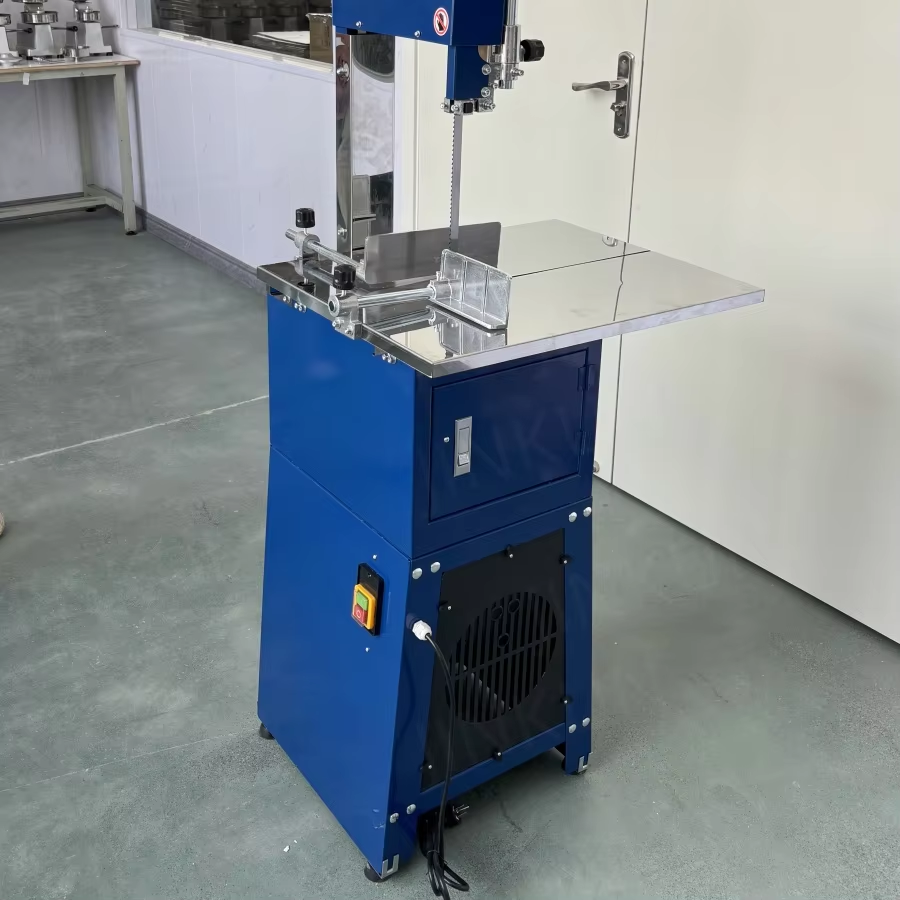
Core Precision Mechanisms of Modern Bone Saw Machines
Adjustable Cutting Guides and ±1 mm Tolerance for Uniform Thickness Control
Modern bone saw machines achieve exceptional consistency through finely adjustable cutting guides that convert operator intent into mechanical precision. By setting guides to exact thicknesses, users eliminate manual estimation—transforming subjective judgment into a repeatable physical constraint. This system maintains a proven ±1 mm tolerance, a benchmark validated by USDA-FSIS process validation standards and widely adopted in USDA-inspected facilities for portion-controlled bone-in cuts. Such tight control ensures predictable downstream outcomes: standardized packaging, accurate weight-based pricing, and minimal over-trimming. Integrated with calibrated tables and dynamic tension controls, the guide system ensures input settings translate faithfully into output—reducing operator variability and improving yield by up to 2.1% in high-volume processing lines.
Blade Stabilizers and Rigid Frame Design to Eliminate Lateral Deflection
Precision hinges not only on setup but on structural integrity during operation. High-end bone saw machines employ dual stabilization strategies: blade stabilizers (typically spring-loaded or hydraulic dampeners mounted above and below the cutting plane) and a monolithic, vibration-dampening frame constructed from stress-relieved cast iron or reinforced steel. These features actively counteract lateral deflection—the primary cause of ragged edges, tapered slices, and inconsistent thickness—especially when cutting dense cortical bone or frozen sections. Independent testing by the North American Meat Institute (NAMI) confirms that machines meeting ANSI/ASSE Z245.1-2022 structural rigidity requirements reduce cut deviation by 68% compared to legacy models. The result is clean, square-edged portions essential for premium retail cuts and further processing, directly lowering scrap rates and enhancing visual quality without additional labor.
Advanced Blade Technology Optimized for Meat–Bone Interfaces
Tooth Pitch, Hardened Alloy Selection, and Tension Calibration for Clean Cuts
Optimal blade performance at the meat–bone interface depends on three interdependent engineering choices. First, variable tooth pitch—wider at the gullet for efficient bone chip evacuation, tighter near the back for torsional rigidity—prevents clogging and heat buildup while maintaining tracking stability. Second, hardened alloy selection leverages bi-metallic construction: high-carbon tool steel bodies for fatigue resistance, paired with cobalt-reinforced or tungsten-carbide-tipped teeth engineered to retain sharpness through repeated impact with calcified tissue. Third, precision tension calibration—verified via digital tension meters per ISO 9001-compliant maintenance protocols—ensures the blade remains taut under dynamic load, preventing drift across sinew, cartilage, or marrow-rich bone. Together, these elements sustain the ±1 mm tolerance established at setup, reducing trim loss by an average of 1.7% across mixed-species processing (beef, pork, lamb), as documented in peer-reviewed studies published in Meat Science (Vol. 183, 2022).
Real‑Time Blade Adjustment Protocols for Variable Material Hardness
Bone density varies significantly—even within a single carcass—making static blade parameters insufficient for consistent results. Modern bone saw machines integrate real-time adjustment protocols using embedded torque sensors, accelerometers, and feed-rate feedback loops. When transitioning from soft muscle to dense femoral cortex, the system detects rising resistance and responds within 15–30 milliseconds: reducing feed rate by up to 40%, increasing blade tension incrementally, and modulating RPM to maintain optimal surface speed (m/s). Some FDA-registered systems also incorporate AI-driven density mapping from pre-scan imaging, enabling anticipatory adjustments. This adaptability preserves cut accuracy across heterogeneous material, ensuring uniform thickness even in variable-weight batches. Facilities deploying such systems report a 2.9% reduction in nonconforming portions and sustained throughput at >92% of rated capacity—proving that intelligence at the cutting edge enhances both quality and efficiency.
Operational Discipline: Maintenance and Calibration for Sustained Precision
Preventive Maintenance Schedule: Blade Alignment, Tension Checks, and Guide Wear Monitoring
Precision degrades not from design flaws—but from unmanaged wear. A disciplined preventive maintenance schedule is the operational bedrock of long-term accuracy. Daily verification of blade tension using calibrated digital gauges (per manufacturer specifications and aligned with ISO 5349-1 hand-arm vibration guidelines) prevents gradual drift. Weekly blade alignment checks—using laser-guided fixtures traceable to NIST standards—ensure vertical and horizontal tracking remains within 0.05° of true. Monthly inspection of cutting guides for groove wear, deformation, or thermal scoring identifies deterioration before it compromises tolerance. Integrating these tasks into a digital CMMS platform enables predictive alerts and audit-ready documentation. Facilities adhering to this regimen extend blade life by 35%, reduce unplanned downtime by 52%, and maintain ±1 mm consistency for over 18 months between major recalibrations—directly supporting yield stability and regulatory compliance.
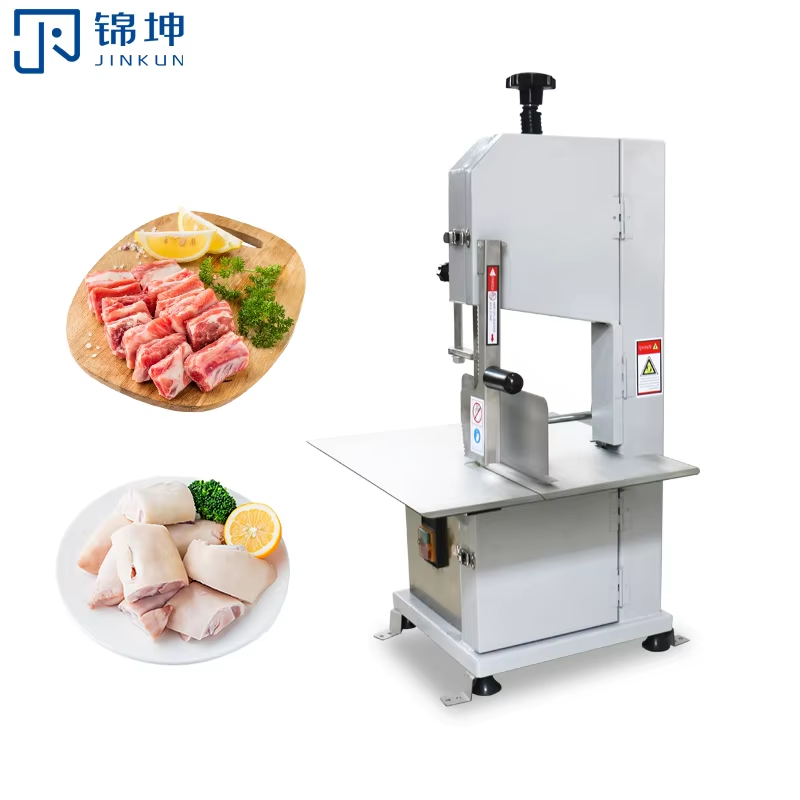
Precision-Driven Business Outcomes: Yield, Consistency, and Cost Efficiency
Quantifiable Yield Gains (3.2% Industry Average) via Reduced Trim Loss and Portion Standardization
The cumulative effect of precision engineering and disciplined operation delivers measurable financial impact. Industry-wide analysis by the Food Marketing Institute (FMI) and USDA AMS data confirms an average 3.2% yield gain across processors who upgraded to modern bone saw systems within the past five years. This uplift stems from two verified drivers: first, reduced trim loss—tighter tolerances cut waste by eliminating “safety margins” previously added manually; second, portion standardization, which improves pack-out efficiency and reduces customer chargebacks for out-of-spec weights. For a mid-sized processor handling 10,000 kg of raw product daily, that 3.2% gain equates to ~320 kg of additional saleable product—translating to over $180,000 in annual gross margin improvement (based on average wholesale bone-in beef values). Critically, these gains require no increase in raw material input or labor headcount—only consistent execution of the machine’s precision capabilities.
FAQ
What is the significance of ±1 mm tolerance in bone saw machines?
The ±1 mm tolerance ensures consistent and precise portioning of bone-in cuts, reducing waste and enabling predictable downstream processes like standardized packaging and accurate pricing.
How do blade stabilizers improve the performance of bone saw machines?
Blade stabilizers prevent lateral deflection during cutting, ensuring smoother and more accurate cuts, reducing scrap rates, and enhancing visual quality for premium retail cuts.
What role does preventive maintenance play in bone saw machine precision?
Preventive maintenance—such as blade alignment, tension checks, and guide wear monitoring—ensures that machines maintain their accuracy over time, extending blade life and reducing downtime.
How do real-time blade adjustments work in modern saw machines?
Real-time adjustments use sensors and feedback loops to modulate feed rates, blade tension, and RPM based on material hardness, maintaining cut accuracy even with material variability.
What are the financial benefits of using modern bone saw machines?
Modern bone saw machines deliver a 3.2% yield gain on average, which leads to higher saleable product output, reduced trim loss, and improved profit margins without increasing labor or material costs.
Table of Contents
- Core Precision Mechanisms of Modern Bone Saw Machines
- Advanced Blade Technology Optimized for Meat–Bone Interfaces
- Operational Discipline: Maintenance and Calibration for Sustained Precision
- Precision-Driven Business Outcomes: Yield, Consistency, and Cost Efficiency
-
FAQ
- What is the significance of ±1 mm tolerance in bone saw machines?
- How do blade stabilizers improve the performance of bone saw machines?
- What role does preventive maintenance play in bone saw machine precision?
- How do real-time blade adjustments work in modern saw machines?
- What are the financial benefits of using modern bone saw machines?