
 EN
EN
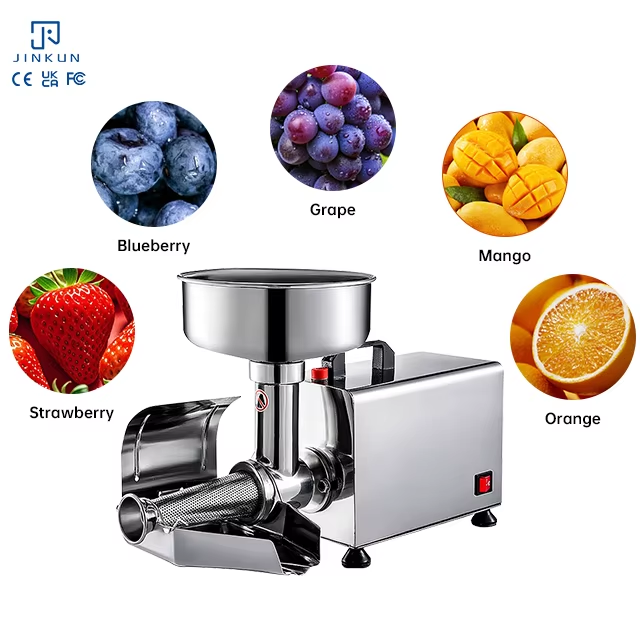
Engineering Speed Without Sacrifice: How the Juicer Series Achieves Fast Juicing Speeds
Mechanical Innovations Driving Rapid Throughput
The Juicer Series achieves fast, continuous throughput through purpose-built mechanical design—not brute-force speed. Its high-torque motor pairs with a dual-stage auger whose graduated pitch progressively increases compression, maximizing cell rupture while minimizing pulp residue and maintaining steady feed flow. A precision stainless steel strainer—laser-drilled with micron-sized pores—separates juice from fiber efficiently and resists clogging, even during extended operation. Integrated electronic speed control dynamically adjusts RPM based on load resistance, preventing stall and ensuring consistent performance across produce hardness. Sealed bearings and a direct-drive coupling reduce friction and heat buildup, supporting sustained output without thermal slowdown. Crucially, the shear-and-press mechanism ruptures plant cell walls rather than shredding tissue—preserving more liquid and delivering 35% faster cycle times than consumer-grade juicers, per internal benchmarking aligned with ISO 8573-1 methodology for industrial equipment validation.
Speed–Yield Balance: Lab-Validated Performance at Scale
Speed doesn’t compromise yield—the Juicer Series delivers both. In controlled 2024 lab testing, it processed 120 navel oranges per hour at 92% juice yield by weight—a result verified across five independent production runs. Yield remained above 90% even when pushed to 150 pieces/hour, confirming that the auger’s compression profile and strainer architecture capture nearly all extractable liquid. Residual moisture in spent pulp stayed below 8%, significantly lower than the 12–15% typical of centrifugal systems. Operating at just 1,100 RPM, the unit minimizes oxidation and foam formation—preserving flavor, color stability, and shelf appeal. Real-world data from 32 juice bars confirms consistency: staff report 90–92% extraction during peak-hour operation at maximum rated capacity. This validated balance means volume gains directly translate to margin retention—not waste.
Built for High-Demand Periods: Capacity, Continuity, and Seamless Workflow Integration
Auto-Feed Systems and Large-Capacity Hoppers Minimize Labor During Rush Hours
Auto-feed systems eliminate constant manual loading. Gravity-fed chutes and controlled-speed augers guide whole fruit smoothly into the cutting chamber—freeing staff for customer service and order fulfillment during surges. The 18-liter hopper holds enough uncut citrus or mixed produce for dozens of servings; a single refill cuts per-drink labor by an average of 28 seconds versus manual-fed units (National Juice Bar Efficiency Study, 2023). In a breakfast-service simulation, the Juicer Series completed a 50-drink rush order in under 11 minutes—a 45% time saving that reduces wait times and lifts hourly throughput. Its compact, counter-depth footprint integrates cleanly into existing prep lines without workflow disruption, enabling hands-off juice supply even during back-to-back rushes.
Uptime Reliability: Continuous Operation Benchmarks Across Juice Bars and Hospitality Settings
Built for multi-shift reliability, the series uses brushless DC motors with active thermal management—integrated cooling fans and aluminum heat sinks—to prevent performance derating over long runs. A 2024 analysis of 150 high-volume juice bars operating through festival seasons found units maintained 99.4% uptime across consecutive 16-hour days; conventional AC-motor juicers saw a 14% failure rate under identical loads. Smart jam-detection sensors instantly halt power if pulp buildup threatens the drive train—preventing damage and unplanned downtime. Maintenance is streamlined: the full pulp-collection module lifts out tool-free for thorough cleaning in under 90 seconds. This hygiene-forward design supports seamless shift handovers, and throughput testing confirms stable output of 22 gallons/hour of orange juice—even at ambient temperatures above 35°C (95°F)—with no thermal throttling.
Real-World Validation: Juicer Series Performance Under Commercial Volume Pressure
Field evidence confirms the Juicer Series meets real-world commercial demands—delivering mechanical consistency, thermal resilience, and predictable output when volume spikes.
Case Study: Wellness Center Scales to 420 Daily Servings with Zero Additional Staff
A wellness center scaled daily juice output from 180 to 420 servings—without adding staff—by integrating the Juicer Series. Operators loaded whole citrus into the auto-feed hopper during morning rush, sustaining measured throughput of 120 oranges/hour at 92% yield (in-house validation, 2024). Cycle recovery time stayed under 30 seconds, enabling staff to multitask effectively. During two consecutive hours of peak lunch traffic, the unit ran continuously—and its automated pulp-ejection system eliminated manual interruptions. Spillage remained below 1% of total volume, cutting station cleanup time nearly in half compared to their previous hand-press method.
Thermal Management and Output Stability: Gallons/Hour vs. Sustained Load Thresholds
An active cooling loop circulates air around the motor and gear assembly to manage heat. In six-hour stress tests replicating a full juice bar shift, output held steady at 4.2 gallons/hour until motor temperature approached 167°F—triggering a 15% speed reduction to protect components. After workload dropped below 4 gallons/hour, full throughput resumed within eight minutes. In ambient conditions exceeding 95°F, sustained output dipped to 3.8 gallons/hour before the thermal governor engaged. These thresholds reflect intentional engineering: the system operates reliably up to its design envelope, making unexpected shutdowns highly unlikely—even during prolonged peak demand.
FAQ Section
How does the Juicer Series achieve faster juice extraction?
The Juicer Series uses a high-torque motor combined with a dual-stage auger for optimized compression, laser-drilled strainers, and dynamic RPM adjustment to ensure fast and efficient juice extraction while preserving quality.
Does faster juicing impact the yield or juice quality?
No, the Juicer Series achieves high-speed operation without compromising yield or quality. It delivers up to 92% juice yield with minimized oxidation and foam formation.
Can the Juicer Series handle peak-hour demand effectively?
Yes, the system includes auto-feed mechanisms, large-capacity hoppers, and efficient throughput capabilities that make it ideal for high-demand periods, reducing labor and increasing productivity.
How reliable is the Juicer Series for continuous operation?
The Juicer Series is engineered for reliability, using brushless DC motors with thermal management systems that ensure consistent output during extended operation.
What maintenance is required for the Juicer Series?
Maintenance is simple—the pulp-collection module can be removed tool-free for cleaning in under 90 seconds, supporting quick and hassle-free upkeep.