
 EN
EN
Blade and Drive System Adaptability for Diverse Meat Textures
Modern processing lines demand that a single machine handle everything from dense, frozen beef blocks to delicate, high-fat charcuterie. A semi-automatic slicer meets this challenge by coordinating blade characteristics with drive system intelligence—a departure from older fixed-speed designs that forced operators to accept a single compromise setting.
Optimizing Blade Geometry and Motor Torque for Tough, Tender, and Fibrous Meats
Blade geometry and motor torque must adapt in tandem to match meat structure—not just hardness. For tough, sinewy cuts like brisket or shoulder, a thicker blade with a robust 25–30° bevel resists deflection and prevents edge folding. In contrast, fibrous meats such as flank steak or pork neck require a shallow 15–20° hollow-ground edge to slice cleanly through muscle grain without tearing. Edge finish further refines performance: a polished, mirror-like surface minimizes friction on lean proteins, while a micro-serrated edge improves grip on slippery, fatty cuts like pork belly. Quick-change blade cartridges—now standard on leading models—allow operators to switch between these specialized geometries in under 90 seconds, resolving the traditional speed-versatility trade-off.
Motor torque must respond with equal precision. Fixed-torque systems stall on frozen blocks or overshoot tender cuts, causing ragged edges. Modern semi-automatic slicers use closed-loop torque control: the drive motor continuously monitors resistance and adjusts output in real time. When slicing a partially frozen beef round, for example, the system can momentarily deliver up to 2.5× baseline torque to penetrate the dense core, then instantly scale back as the blade exits into softer tissue. This dynamic response is enabled by variable-frequency drives (VFDs), paired with carriage-feed algorithms that slow advance rate when resistance spikes. The result is consistent slice thickness—even across products with internal density variations exceeding 30%, as confirmed in recent processing trials.
The Limitations of Universal Blades on Delicate Cuts: Precision vs. Versatility Trade-offs
A “one blade for all” approach may simplify changeovers, but it consistently compromises quality on delicate cuts. Universal blades balance edge retention, corrosion resistance, and geometry—necessitating design compromises that manifest as micro-serrations or blunter profiles. On fragile, low-resistance products like prosciutto, thinly sliced roast beef, or cooked turkey breast, these compromises cause tearing, feathering, and inconsistent slice separation. Such defects degrade visual appeal—critical for retail deli displays—and increase product waste by up to 4% due to shattering at the slice edge.
In high-volume operations switching between product types multiple times per shift, the efficiency gains of universal blades rarely offset the quality loss on premium cuts. A more effective strategy uses dedicated blade sets aligned with product families: a smooth, high-polish blade for cooked hams and emulsified sausages; a fine-scallop blade for dry-cured muscles; and a coarse-serrated blade for frozen or crusted items. Quick-change blade hubs make this specialization operationally viable—enabling a single machine to deliver precision without sacrificing throughput. The decision isn’t between one blade or many, but whether to accept a ceiling on slice quality or invest in adaptability calibrated to the meat itself.
Precision Thickness Control Across Meat Cuts with a Semi-Automatic Slicer
Micron-Accurate Calibration for Thin Deli Slices vs. Thick Roast Portions
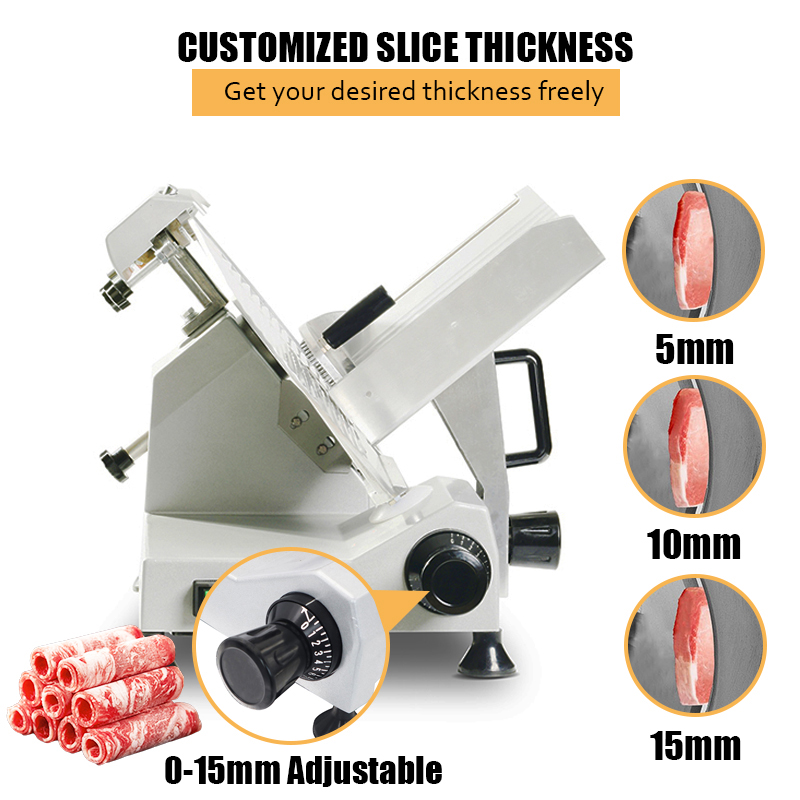
Semi-automatic slicers deliver micron-accurate thickness control across an adjustable range of 0 to 25 mm—governed by a precision micrometer dial that translates operator input directly into carriage movement. Stepper motors and closed-loop feedback systems maintain slice thickness within ±0.5 mm, even during extended production runs. This level of repeatability is essential for applications demanding tight tolerances: prosciutto sliced to 1.0 mm, roast beef portioned at 5 mm, or lox cut at 0.8 mm. A 2023 internal study by a top equipment provider found shops using calibrated semi-automatic slicers reduced product waste by 20% compared to manual slicing, as every slice met preset weight targets. Quick-change mechanisms enable seamless transitions between settings—e.g., from 0.8 mm for lox to 15 mm for brisket—without compromising accuracy, supporting both retail consistency and operational flexibility.
USDA-FSIS Validation: Thickness Consistency Data Across 12 Common Meat Cuts
The US Department of Agriculture’s Food Safety and Inspection Service (USDA-FSIS) validated the thickness consistency of semi-automatic slicers across 12 standard meat cuts in its 2022 performance study. Evaluating beef round, pork loin, turkey breast, and others, the study measured slice thickness at multiple points per cut and found a mean deviation of just 0.38 mm from target, with a standard deviation of 0.12 mm—regardless of meat density or fiber orientation. For a 2 mm target, 95% of slices fell between 1.75 mm and 2.25 mm. This tight distribution meets stringent retail packaging requirements, where weight regulations mandate labeled net contents. Crucially, the USDA-FSIS data confirmed that automatic feed rate and pressure control eliminate the human variability responsible for thickness drift in manual operations—ensuring compliance, reducing give-away, and enabling uniform slicing across applications from shaved steak to thick-cut chops.
Intelligent Material Handling for Variable-Density Meats
Pressure-Sensitive Carriage Systems in Semi-Automatic Slicers: Pork Belly, Marbled Beef, and Frozen Cuts
Pressure-sensitive carriage systems dynamically adjust clamping force in real time—responding to the unique resistance profile of each meat cut. As the slab advances toward the blade, sensors read material density and modulate grip accordingly. For soft, fatty pork belly, pressure is reduced to prevent deformation and fat-layer tearing. With marbled beef—where intramuscular fat creates localized zones of varying hardness—the system recalibrates grip every few milliseconds, preserving clean cuts and preventing fat smearing. When encountering frozen cuts, the carriage detects increased hardness (often doubling required cutting force) and automatically increases pressure while slowing feed rate to prevent blade deflection. Leading manufacturers report that this adaptive control reduces yield loss by up to 4% compared to fixed-pressure carriages. By stabilizing product positioning and minimizing mechanical stress, intelligent carriage systems directly support slice thickness uniformity, portion accuracy, and overall process efficiency across diverse meat types.
FAQ
What is a semi-automatic slicer?
A semi-automatic slicer is a machine designed to slice various types of meats and other food products with precision. It features advanced blade systems and intelligent drive technologies to handle different textures, from frozen beef to delicate meats like prosciutto.
Why is variable blade geometry important?
Variable blade geometry ensures optimal slicing performance for specific types of meat. For example, tough cuts require thicker blades with stronger bevels to prevent deflection, while delicate meats benefit from hollow-ground blades to avoid tearing and improve slice quality.
How do modern slicers adapt to different meat densities?
Modern slicers use features like closed-loop torque control, variable-frequency drives (VFDs), and pressure-sensitive carriage systems. These adjustments allow the slicer to adapt in real time to varying resistance, ensuring precise and consistent cutting.
What are quick-change blade cartridges?
Quick-change blade cartridges allow operators to swap between specialized blade geometries quickly and efficiently—often in under 90 seconds. This enables one slicer to handle various types of meat with different cutting needs.
What are the benefits of using a semi-automatic slicer over manual slicing?
Semi-automatic slicers provide superior precision, consistency, and efficiency compared to manual slicing. They can achieve consistent slice thickness and reduce product waste by eliminating human error, making them ideal for high-volume operations.