
 EN
EN
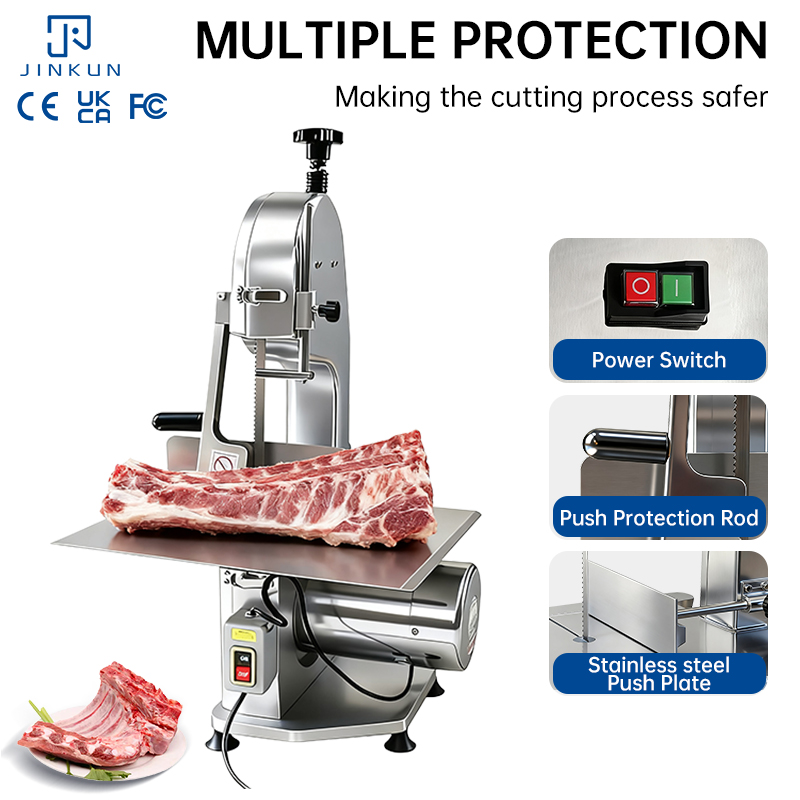
Thermal and Mechanical Demands on Bone Saw Machine Blades
How Continuous Cutting Generates Heat Buildup and Microstructural Fatigue
In a bone saw machine, the blade’s repeated engagement with dense cortical bone and connective tissue generates substantial frictional heat. Without adequate cooling, the cutting edge can rapidly exceed 47°C—a threshold known to cause thermal necrosis in bone tissue (Lee et al., 2018). This localized temperature spike not only compromises product integrity but also accelerates microstructural fatigue in the blade itself. Cyclic thermal loading gradually tempers the martensitic structure, reducing hardness and promoting micro-crack formation at the cutting edge. As cutting continues, these cracks propagate under mechanical stress, leading to premature edge rounding, increased cutting force, and eventual blade failure. The severity of fatigue is directly linked to duty cycle: high-throughput abattoir operations may complete hundreds of cuts per hour—far exceeding the thermal dissipation capacity of standard blade materials. Consequently, blade life is governed by the interplay between cutting speed, feed rate, and the material’s resistance to thermal softening.
Edge Retention vs. Toughness: Balancing HRC Hardness and Fracture Resistance
A blade’s hardness—measured on the Rockwell C scale (HRC)—directly determines edge retention. Higher HRC values (above 60) yield a finer, more durable edge that resists abrasive wear but increase brittleness, raising the risk of chipping or catastrophic fracture when encountering hard bone or unexpected nodules. Conversely, lower HRC (below 54) improves toughness and shock absorption, yet results in rapid dulling under heavy-duty use, requiring frequent resharpening. The optimal balance for bone saw blades lies in the 56–58 HRC range. At this level, the microstructure retains sufficient martensite for edge stability while preserving ductility to absorb impact without fracturing—a critical requirement in commercial settings where blade failure risks production halts and safety incidents. Selecting steel with refined carbide distribution and a tempered martensite matrix supports this balance, extending service intervals and lowering total cost of ownership.
Carbon Steel vs. Stainless Steel Blades for Bone Saw Machines
Carbon Steel: Sharpness Advantage and Vulnerability to Corrosion in Wet Environments
Carbon steel blades—typically containing 0.6–1.5% carbon—achieve 58–62 HRC, delivering superior initial sharpness and minimal deflection during bone cutting. This fine-grained structure reduces cutting force and improves yield. However, the absence of chromium leaves the surface unprotected against oxidation. In wet processing environments—exposed to blood, saline solutions, and high-humidity cleaning protocols—carbon steel rapidly develops rust and pitting. Even light surface patina can harbor bacteria, violating USDA hygiene standards. Once corrosion initiates, micro-edge degradation accelerates, leading to micro-fractures and premature failure. While unmatched for raw sharpness, the intensive maintenance required—frequent oiling, drying, and controlled storage—makes carbon steel impractical for continuous, high-volume meat processing where sanitation and operational continuity are non-negotiable.
Stainless Steel: Corrosion Resistance and Trade-offs in Resharpening Frequency
Stainless steel blades—containing ≥10.5% chromium—form a self-repairing passive oxide film that delivers robust resistance to rust and organic acid attack, making them the industry standard for USDA-compliant abattoirs. This corrosion resistance eliminates pitting, maintains surface integrity, and ensures consistent hygienic performance across shifts. The trade-off lies in hardness: most stainless grades operate at 52–58 HRC, resulting in faster edge rolling and dulling during abrasive bone cutting. Frequent resharpening is necessary to sustain throughput, and the material’s inherent toughness increases sharpening effort. Advanced variants like 440C—enriched with carbon and chromium carbides—improve wear resistance, while cryogenic treatments further refine microstructure to extend edge life. Despite higher upfront costs, stainless steel’s durability in wet, high-stress environments typically yields lower total cost of ownership by reducing replacement frequency, cleaning downtime, and contamination risk.
Optimal Stainless Steel Grades for Commercial Bone Saw Machine Applications
AISI 420, 440C, and 17-4PH Nitrided Blades: Performance Comparison in USDA-Compliant Abattoirs
In USDA-compliant bone saw applications, blade grade selection must reconcile hardness, corrosion resistance, and impact toughness. AISI 420—a martensitic stainless steel—reaches 48–52 HRC after heat treatment, offering acceptable sharpness but demanding frequent resharpening in continuous operation. Its 12–14% chromium content provides moderate protection in wet environments, though prolonged exposure to saline carcass fluids can lead to edge pitting. AISI 440C, with higher carbon (0.95–1.20%) and 16–18% chromium, achieves 58–60 HRC and superior wear resistance—but its increased hardness slightly reduces fracture toughness, raising susceptibility to microchipping upon contact with bone knots. The 17-4PH precipitation-hardening stainless steel, when nitrided, resolves this tension: it develops a surface hardness exceeding 60 HRC while retaining a tough martensitic core (tensile strength >200,000 psi). This dual-phase architecture minimizes edge deformation and extends service intervals. Crucially, the nitrided layer’s dense, non-porous structure inhibits bacterial adhesion—supporting rigorous sanitation protocols. Abattoir trials confirm 17-4PH nitrided blades deliver a 40% longer mean time between resharpening versus 440C, directly reducing blade-change downtime in high-throughput facilities.
Advanced Coatings and Hybrid Materials Extending Bone Saw Machine Blade Life
To combat wear and corrosion in high-volume bone saw operations, manufacturers increasingly adopt advanced coatings and hybrid materials.
TiN and CrN PVD Coatings: Quantifiable Gains in Mean Time Between Failures (MTBF)
TiN (titanium nitride) PVD coatings reduce abrasive wear by 45% compared to uncoated blades, significantly increasing mean time between failures (Journal of Tribology). Applied via physical vapor deposition, the thin, hard ceramic layer enhances surface hardness without compromising substrate toughness—an essential trait for impact resistance in bone saw applications. CrN (chromium nitride) coatings provide superior corrosion resistance, extending MTBF by an additional 15–20% in wet processing environments. When deployed strategically—such as CrN over a TiN base layer—these coatings can double operational blade lifespan, minimizing unplanned downtime and maintenance labor in continuous-abattoir settings.
Frequently Asked Questions (FAQ)
Q: What causes thermal fatigue in bone saw machine blades?
A: Thermal fatigue occurs due to repeated heat buildup caused by friction between the blade and dense cortical bone during cutting, which compromises the blade’s martensitic structure and accelerates micro-crack formation.
Q: How do HRC values affect a blade's performance?
A: Higher HRC values enhance edge retention and wear resistance but may lead to brittleness, increasing fracture risks. Lower HRC values improve toughness but result in faster dulling, necessitating frequent resharpening.
Q: Why is stainless steel preferred for bone saw machine blades in wet environments?
A: Stainless steel’s chromium content forms a passive oxide film that resists rust and pitting, ensuring hygienic performance and reducing corrosion-related failures in wet processing environments.
Q: What are the advantages of TiN and CrN coatings on blades?
A: TiN coatings reduce abrasive wear, while CrN coatings enhance corrosion resistance. Together, they improve blade durability and minimize unplanned downtime in high-stress meat processing applications.