
 EN
EN
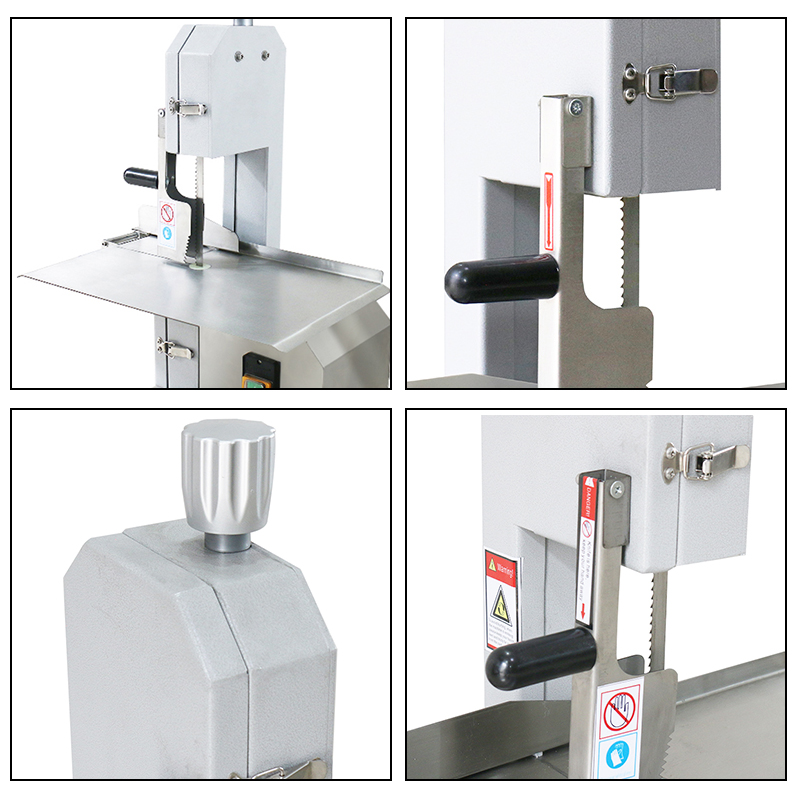
Point-of-Operation Guarding: Essential Physical Protection on Bone Saw Machines
Static and dynamic blade guards: Design principles for preventing direct contact
The point of operation—the precise zone where the blade contacts the product—is the highest-risk area on a bone saw machine and demands the most robust guarding. Static guards are fixed, non-moving barriers that fully enclose the blade assembly, leaving only the minimum opening required for the cut. Typically constructed from stainless steel or high-impact polycarbonate, they must be securely fastened to resist tampering and vibration-induced loosening. Dynamic guards, such as self-adjusting shields, automatically rise as the operator advances the product and retract immediately after the cut—ensuring continuous protection without manual intervention. Both types must satisfy OSHA 1910.212(a)(3)(ii): they must prevent any part of the operator’s body from entering the hazard zone. Because bone fragments and debris strike guards at high velocity, materials and mounting must withstand repeated impact without cracking, warping, or dislodging. A well-designed guard never compromises safety for convenience—it remains intact, functional, and effective under heavy daily use.
Guard rings, adjustable shields, and feed-angle limiters — balancing safety and usability
Guard rings provide a continuous circumferential barrier around rotating blades, while adjustable shields let operators tailor exposure for varying product sizes—especially useful for irregular cuts—and can be repositioned tool-free. Feed-angle limiters restrict how the product approaches the blade, eliminating dangerous side-loading and forcing safer hand placement. The key is maintaining protection without undermining ergonomics or throughput: a guard that induces awkward posture increases slip or strain risk. ANSI B11.19 emphasizes practicality—guards must encourage consistent, correct use. Features like quick-release mechanisms for cleaning, tool-free adjustment, and optical clarity (e.g., polycarbonate with anti-scratch coating) ensure operators can see the cut line clearly and adapt the guard in seconds. When usability aligns with safety, bypassing becomes unnecessary—and injury rates drop significantly, even in high-volume commercial kitchens.
Hazardous Motion Control: Safeguarding Against Rotating and Reciprocating Risks in Bone Saw Machines
On a bone saw machine, the convergence of rotating, reciprocating, and transverse motions creates a uniquely complex hazard profile. Inadequate motion control contributes to nearly half of all rotating-equipment injuries—making integrated safeguards essential.
How rotating blades, reciprocating arms, and transverse motion create injury pathways
- Rotating blades and shafts generate powerful entanglement forces. Loose clothing, gloves, or hair drawn into nip points at blade-housing interfaces can cause severe lacerations or amputations.
- Reciprocating arms, such as cutting carriages or pusher mechanisms, create trapping zones. An operator’s hand or arm may be caught between the moving part and a fixed structure—resulting in crush injuries on each stroke.
- Transverse motion, seen in rail-mounted or conveyor-linked feed systems, forms in-running nip points at sprockets, rollers, and guide channels—posing shear and draw-in hazards with minimal warning.
These motion types rarely occur in isolation; their overlap multiplies risk. A rotating blade may fling debris just as a reciprocating arm exposes a new pinch point—demanding layered, coordinated protection—not standalone fixes.
Integrated safeguards — from debris containment to moving-part isolation
Effective motion control starts with fixed enclosures, fully surrounding blades and power-transmission components using bolted or welded stainless steel housings that eliminate direct access. Where loading requires openings, interlocked guards cut power instantly if displaced—even slightly—preventing inadvertent contact during maintenance or adjustment.
Debris containment is built into the design: polycarbonate shields and angled chip deflectors redirect bone fragments and cutting fluid away from the operator while preserving full visibility of the cut line. For reciprocating arms, telescopic bellows or accordion-style covers fully encase linear slides, and displacement-sensitive limit switches halt motion if coverage is compromised. Together, these measures form a unified physical and functional barrier—active at every phase of the sawing cycle.
Secondary Safety Systems: Reinforcing Guarding with Emergency Controls and Mechanical Stabilization
Secondary safety systems add critical redundancy when primary guarding is bypassed—or when unexpected events occur. Emergency stop controls, positioned along the entire operator interface (e.g., palm pads, knee bars, foot pedals), deliver sub-100-millisecond shutdown of the blade upon activation—designed so operators can trigger them without releasing the workpiece or losing balance. Mechanical stabilization further reduces risk: precision-engineered clamping systems hold bone or material firmly in place, preventing sudden shifts that could pull hands toward the blade.
Two-hand controls enforce safe positioning by requiring simultaneous activation and sustained pressure—keeping both hands well clear of the hazard zone during the high-risk cutting phase. On bone saw machines, this is typically paired with a time-delay relay that halts operation within 200 ms if either hand is removed, preventing workarounds. Still, two-hand controls alone cannot protect nearby personnel or prevent post-cycle reach-in—so they’re most effective when combined with physical barriers and presence-sensing devices like light curtains.
When properly integrated, secondary systems do more than react—they shape behavior. Knowing that releasing a hand control stops the blade instantly, or that stepping on an emergency bar halts all motion, encourages deliberate pacing and disciplined technique. Facilities that layer robust primary guarding with responsive secondary controls and mechanical stabilization consistently report the steepest declines in laceration incidents on bone cutting equipment.
Regulatory Compliance and Real-World Effectiveness of Bone Saw Machine Guarding
OSHA 1910.212 and ANSI B11.19: Key requirements for bone saw machine point-of-operation guarding
OSHA 1910.212 mandates that point-of-operation hazards on bone saw machines be fully guarded to prevent any part of the operator’s body from entering the danger zone during operation. Guards must be securely attached, not introduce new hazards (e.g., sharp edges), and withstand operational forces—including impact from bone fragments and blade vibration. For bone saws, this translates to fixed or adjustable blade guards—often paired with transparent polycarbonate shields—to maintain visibility without compromising protection.
ANSI B11.19 refines these expectations with performance-based criteria: guards must resist deflection beyond 2 mm under 1,000 N of force, interlocks must cut power within 100 ms of guard displacement, and removable guards must be interlocked to prevent operation when open. Critically, the standard requires a documented risk assessment—given bone saws’ high rotational speeds and potential for blade fracture, guards must be rated to contain projectiles. Compliance isn’t optional: OSHA’s machine guarding violations ranked among the top 10 most cited standards in 2023, with over 1,400 citations issued. Facilities that implement these requirements holistically—not as checkboxes but as engineered systems—see measurable outcomes: audits show up to a 70% reduction in contact injuries. Ultimately, OSHA and ANSI standards transform guarding from passive hardware into an enforceable, life-saving barrier between operator and blade.
FAQ Section
What is point-of-operation guarding on a bone saw machine?
It refers to safety measures designed to protect operators from hazards at the point where the blade meets the product. This includes static and dynamic guards that prevent direct access to the blade while allowing the machine to function efficiently.
What are static and dynamic blade guards?
Static guards are fixed barriers that enclose the blade, while dynamic guards are movable shields that adjust automatically during operation to ensure continuous protection without manual effort.
What safety features prevent entanglement in bone saw machines?
Rotating blades, reciprocating arms, and transverse motions can create hazards. Safety measures such as fixed enclosures, interlocked guards, and debris containment features are essential to prevent entanglement and injuries.
How do secondary safety systems work on bone saw machines?
Secondary safety systems, like emergency stop controls and two-hand control mechanisms, provide additional safeguards. They can immediately stop blade motion in emergencies and enforce safe operational procedures.
Why is compliance with OSHA and ANSI standards important?
Compliance with OSHA 1910.212 and ANSI B11.19 ensures that bone saw machines have adequate safety measures in place, significantly reducing injury risks and fostering safer workplace environments.
Table of Contents
- Point-of-Operation Guarding: Essential Physical Protection on Bone Saw Machines
- Hazardous Motion Control: Safeguarding Against Rotating and Reciprocating Risks in Bone Saw Machines
- Secondary Safety Systems: Reinforcing Guarding with Emergency Controls and Mechanical Stabilization
- Regulatory Compliance and Real-World Effectiveness of Bone Saw Machine Guarding